Research Overview
My research uses gravitational lensing to map dark matter across a broad range of scales, from galaxy cluster cores to the surrounding cosmic web. I develop lensing mass reconstruction algorithms and apply them to deep and wide-field imaging. I use galaxy distributions, intracluster light, X-ray, and radio observations to interpret the resulting mass maps. These analyses probe cluster mass structure, merger geometry, and the connection between cluster cores and their larger scale environments.
- Merging clusters and dark matter I use JWST strong and weak lensing observations and HST, X-ray, radio, and intracluster light data to reconstruct mass structure and study merger geometry in systems such as the Bullet Cluster and Abell 2744.
- Cluster outskirts and filamentary structure I use weak lensing over wide fields to detect and characterize intracluster filaments and to connect cluster mass structure with the surrounding large scale structure. I also develop deep learning tools for mass mapping in future surveys.
- Mass reconstruction methods I develop MARS and MrMARTIAN, which provide free form and hybrid approaches to cluster lensing mass reconstruction. They use maximum entropy regularization, automatic differentiation, and modern optimization techniques to explore large parameter spaces.
Featured Publications
A High-Caliber View of the Bullet Cluster Through JWST Strong and Weak Lensing Analyses
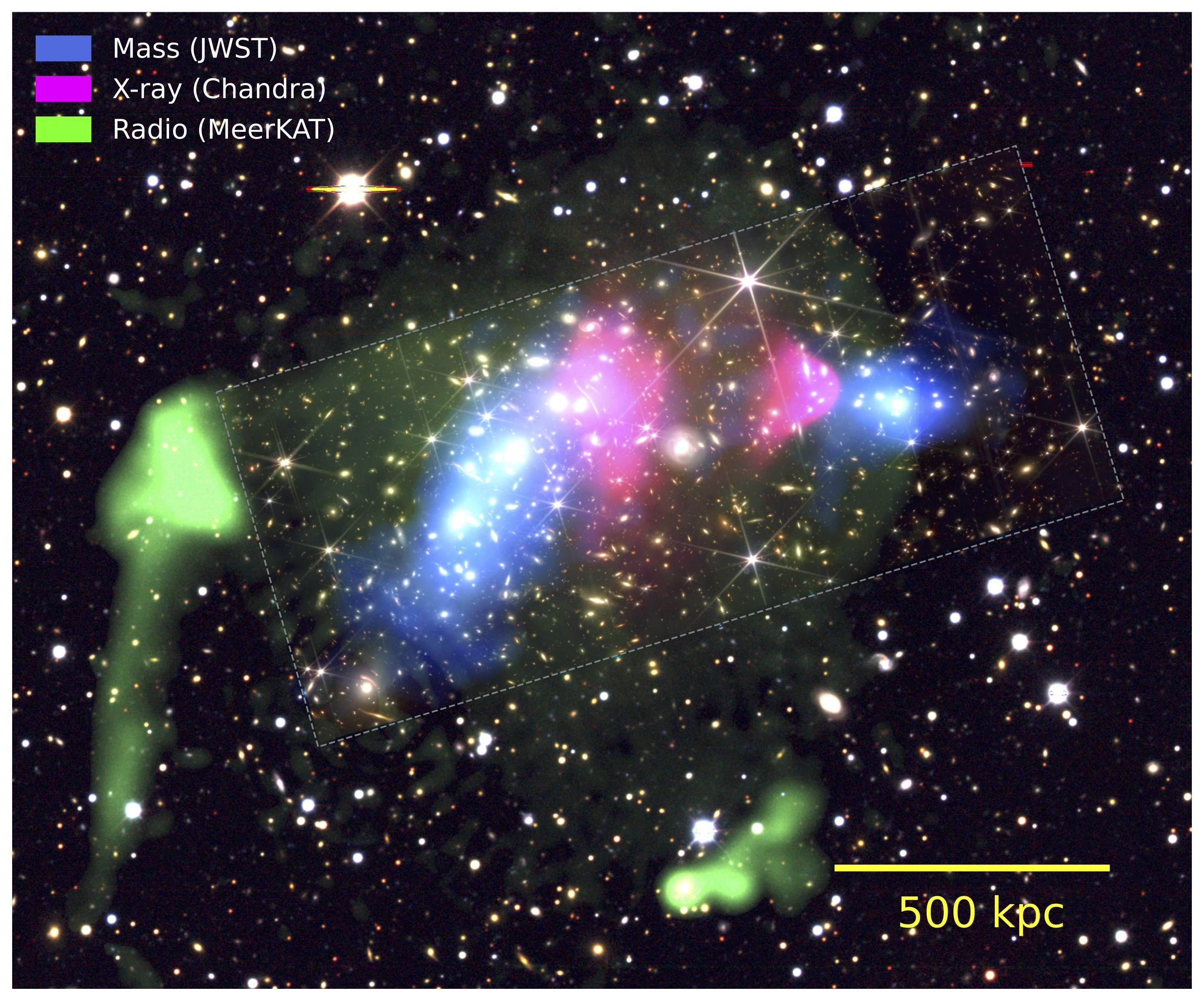
The clear offset between the gravitational lensing mass distribution and the X-ray emitting hot gas in the Bullet Cluster provided direct empirical evidence for the existence of dark matter. Using JWST strong and weak lensing observations, we reconstructed a detailed map of its projected mass distribution and examined the mass structure and merger geometry of the system. Our analysis also revealed a strong morphological similarity between the intracluster light and the lensing mass distribution.Lensing mass map
Precision MARS Mass Reconstruction of A2744: Synergizing the Largest Strong-lensing and Densest Weak-lensing Data Sets from JWST
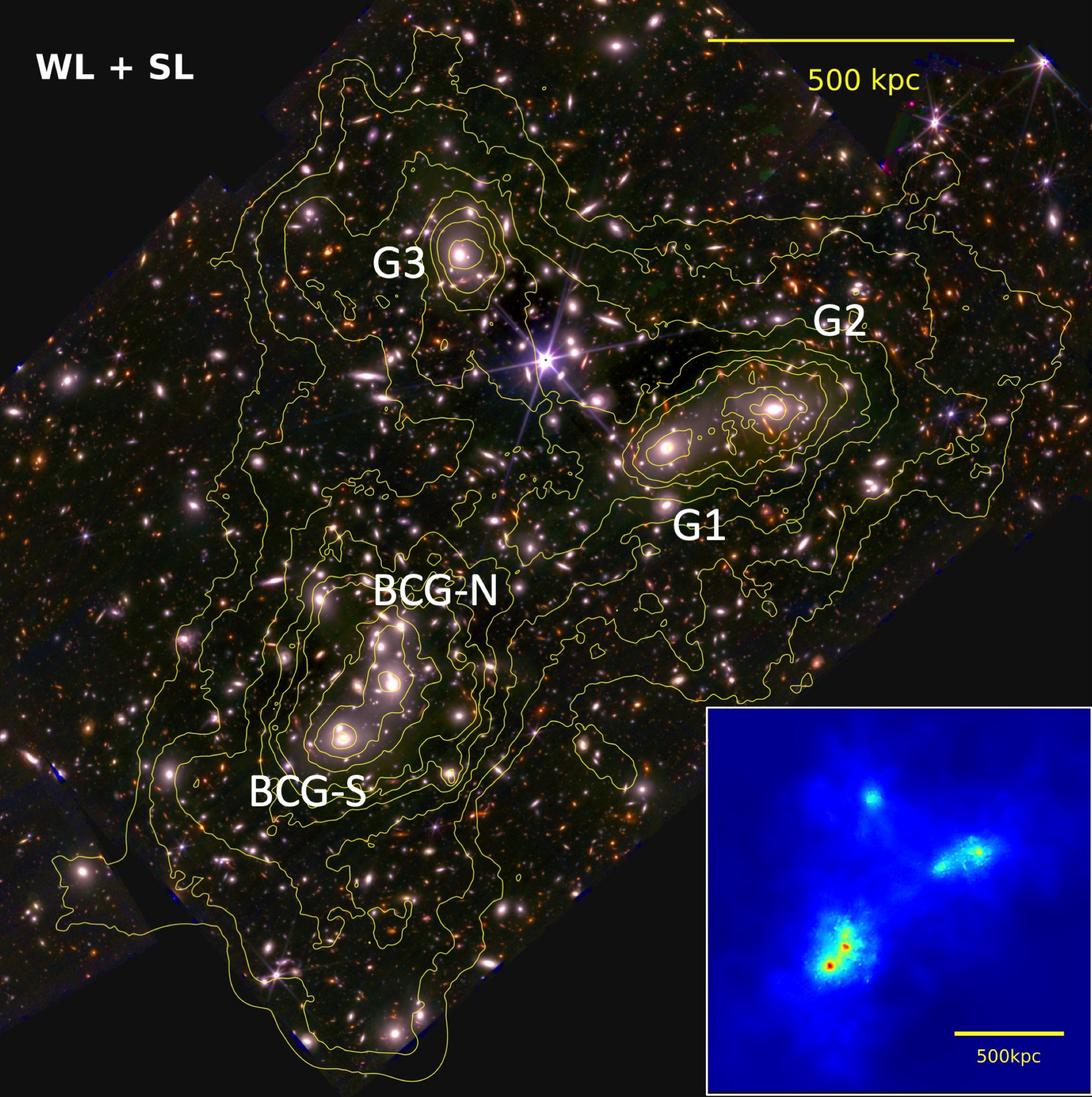
Abell 2744, also known as Pandora’s Cluster, is a complex merging system containing multiple mass components. Using deep JWST strong and weak lensing observations, we reconstructed a high-resolution map of its projected mass distribution. The map reveals two mass bridges connecting the main mass clumps. With the orientation of observed radio relics, we propose the merger axes of Abell 2744. In a subsequent study (link), we found that the directions of intracluster filament candidates around Abell 2744 are broadly consistent with these merger axes.Lensing mass map